

Christian messaging in streetwear: motivation and faith
TL;DR:
- Christian streetwear uses faith-inspired visuals to motivate and express belief among youth.
- Authenticity relies on aligning clothing messages with personal faith and lifestyle.
- The market is growing rapidly, reflecting Gen Z’s desire for faith-based cultural expression.
Critics have long argued that wearing your faith on a hoodie is just performative religion, a way to look spiritual without living it. But that take misses something real. For a generation of young believers navigating identity, peer pressure, and a culture that rarely makes space for faith, a bold graphic tee with scripture can be a daily anchor. Christian messaging in streetwear is not about showing off. It is about showing up. This article breaks down what Christian messaging in streetwear really means, why it motivates youth, how to keep it authentic, and how to wear your beliefs without compromise.
Table of Contents
- What is Christian messaging in streetwear?
- Why Christian messaging motivates youth
- Authenticity and criticism: is Christian messaging performative?
- How to express faith authentically through streetwear
- What most articles miss about Christian messaging
- Explore faith-inspired streetwear for authentic expression
- Frequently asked questions
Key Takeaways
| Point | Details |
|---|---|
| Authentic faith expression | Christian streetwear empowers youth to display their beliefs when messaging is chosen and worn authentically. |
| Market growth | Faith-based apparel is booming, reflecting both spiritual motivation and street culture appeal among Gen Z. |
| Avoid performative messaging | Messages should align with lifestyle and belief to avoid superficial expressions of faith. |
| Practical guidance | Choosing the right apparel means mixing style with sincere values for effective, authentic faith expression. |
What is Christian messaging in streetwear?
Christian messaging in streetwear refers to apparel that carries faith-inspired content, whether that is a Bible verse, a cross graphic, a phrase like “Stay Zealous,” or a symbol rooted in Christian tradition. It is not Sunday church clothes. It is hoodies, tees, joggers, and caps built in the visual language of street culture but carrying a spiritual message.
The roots of this movement go back further than most people realize. In the 1970s and 1980s, Christian rock culture began blending faith with counterculture aesthetics. By the 1990s, brands were experimenting with faith-forward graphics on casual wear. But the real shift happened in the 2010s when streetwear itself exploded globally. Young Christians saw an opportunity. If culture was going to be shaped by what people wore, why not shape it with something meaningful?
Today, Christian streetwear motivates youth by integrating faith into street culture, turning apparel into a wearable witness for motivation and expression, especially as traditional religious affiliations among young people continue to decline.
Here are the most common styles of Christian messaging you will find in streetwear today:
- Scripture-based graphics: Direct Bible verses printed in bold typography, often from Psalms, Philippians, or Romans
- Faith phrases: Motivational statements like “Fear Not,” “Chosen,” or “Stay Zealous” that carry theological weight without quoting chapter and verse
- Symbolic imagery: Crosses, doves, flames, and ichthys fish reimagined in modern graphic design
- Cultural remixes: Faith messages blended with hip-hop, skate, or athletic aesthetics to feel native to street culture
- Community-driven drops: Limited releases tied to church events, youth groups, or faith movements that build belonging
Each of these styles serves a different purpose. Some are evangelistic, meant to spark conversation. Others are devotional, reminding the wearer of their own commitment. The best ones do both. When a teenager walks into school wearing “Stay Zealous” on their chest, it is not just a fashion statement. It is a public declaration of what they stand for, and a personal reminder to keep standing.
Why Christian messaging motivates youth
Now that we have defined Christian messaging, let us explore why it resonates so strongly with young people.
Identity is everything during the teenage and young adult years. You are constantly asking who you are, where you belong, and what you believe. Streetwear has always been a tool for answering those questions through style. Wearing a brand signals your tribe. Christian streetwear takes that same psychology and points it toward something eternal.
“Faith is not just something you practice privately. It is something you live publicly, in every space you occupy, including the streets.”
Here is why Christian messaging in streetwear works as a motivational tool for young believers:
- Visible commitment creates accountability. When you wear your faith, you are more likely to live it. The message on your shirt becomes a standard you hold yourself to throughout the day.
- Belonging without compromise. Street culture offers community, and Christian streetwear lets young believers participate in that culture without abandoning their values.
- Daily devotional reminder. A phrase like “Stay Zealous” seen in the mirror every morning is a micro-sermon. It resets your focus before the day even starts.
- Conversation starter for witness. Young people often struggle to bring up faith in casual settings. A bold graphic opens the door without forcing the topic.
- Cultural relevance. When faith looks and feels native to the culture young people already love, it removes the barrier of faith feeling “uncool” or irrelevant.
Christian streetwear motivates youth precisely because it meets them where they already are, in the visual and social language of street culture, and redirects that energy toward God.

Pro Tip: Before buying or wearing a piece of Christian streetwear, ask yourself if the message reflects something you actually believe and live. Authenticity starts with that honest question, not with what looks good on Instagram.
Authenticity and criticism: is Christian messaging performative?
But is this visible faith always genuine? Let us consider the criticisms and the authenticity debate.
The sharpest critique of faith-based apparel is that it commodifies belief. Critics call it performative religion, arguing that wearing Christian messaging without a matching lifestyle reduces faith to a brand identity rather than a lived commitment. That criticism is worth taking seriously.
At the same time, the faith-based apparel statistics tell a different story about demand. The market is not driven by cynicism. It is driven by young people who genuinely want to express belief in a culture-native way.
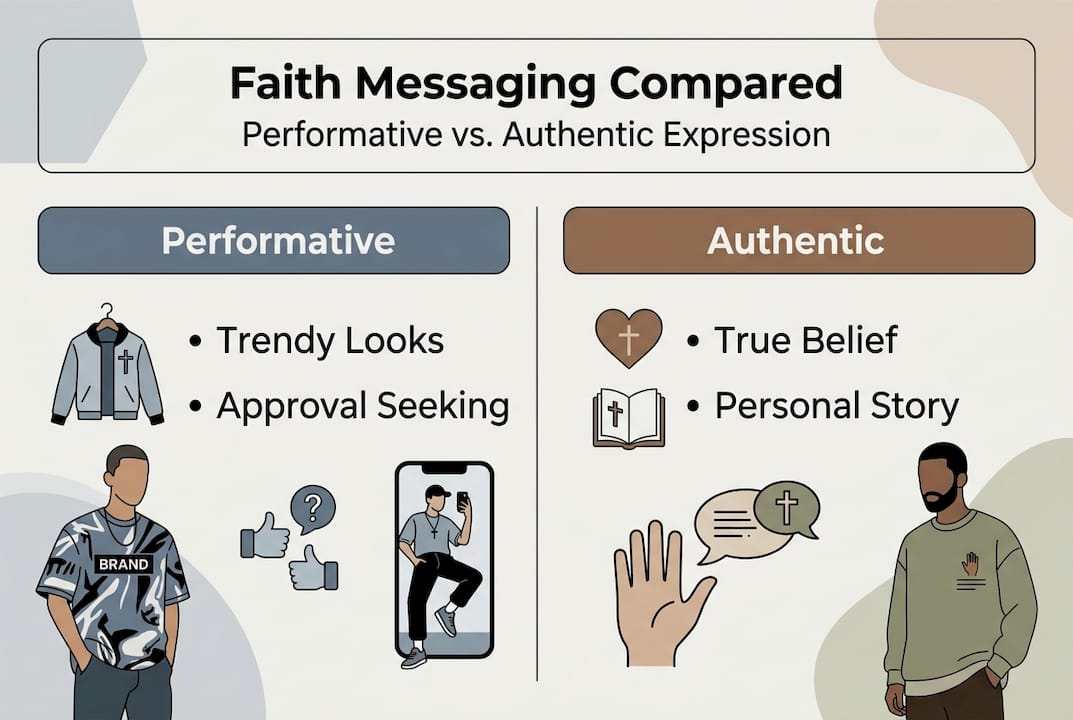
| Feature | Performative messaging | Authentic messaging |
|---|---|---|
| Motivation | Trend appeal, social approval | Personal conviction, faith expression |
| Lifestyle alignment | Inconsistent with stated beliefs | Consistent daily walk with God |
| Message selection | Whatever looks cool | Phrases that carry personal meaning |
| Community impact | Hollow or confusing to observers | Sparks genuine faith conversations |
| Long-term effect | Fades with trends | Deepens commitment over time |
The difference between performative and authentic Christian messaging is not about the design. It is about the heart behind it. A plain white tee with a cross worn by someone living their faith is more powerful than the most expensive streetwear drop worn as a costume.
The faith-based apparel industry is worth $3.7 billion in 2026, which means this is not a niche market. That scale brings both opportunity and responsibility. Brands and buyers alike need to ask whether the message is being honored or just marketed.
The way to avoid the performative trap is straightforward. Wear what you believe. Let your clothing reflect a conversation you are already having with God, not one you are performing for others.
How to express faith authentically through streetwear
Once you understand the authenticity debate, you can make your faith visible without compromising genuineness.
Choosing the right Christian streetwear starts with knowing what you actually believe. Not what sounds inspiring, but what you are genuinely wrestling with, growing in, and committed to. A phrase like “Stay Zealous” hits different when you know what zeal for God actually costs you.
| Market segment | 2026 data |
|---|---|
| Global faith-based apparel market | $3.7 billion |
| Projected growth rate (CAGR) | 5.1% |
| Global streetwear market | $218 billion |
| Streetwear consumers under age 25 | 70% |
These numbers confirm that young people are the heartbeat of streetwear culture, and faith-based apparel is growing right alongside it. That is not a coincidence. It is a generation reclaiming cultural space for belief.
Here is how to express faith authentically through your streetwear choices:
- Start with scripture or phrases you pray or meditate on regularly. If a verse has changed your life, wearing it makes sense. If you just think it looks cool, pause.
- Choose brands whose founders share your values. Research who is behind the brand and whether their story aligns with the message they are selling.
- Wear it in contexts where it matters. Faith-based streetwear is most powerful when worn in everyday spaces, school, work, the gym, not just church events.
- Let it prompt real conversations. If someone asks about your shirt, be ready to actually talk about your faith. The clothing is the opening, not the whole message.
- Prioritize quality and longevity. Cheap, trend-driven pieces fade fast. Invest in pieces that will still mean something to you in two years.
Pro Tip: Build a small capsule of faith-based pieces that genuinely reflect different aspects of your walk with God. Variety keeps the message fresh and prevents it from feeling like a uniform.
What most articles miss about Christian messaging
Most coverage of Christian streetwear focuses on the market size, the aesthetics, or the controversy. What gets overlooked is the actual spiritual mechanics of why this works for young people.
When a teenager wears “Stay Zealous” to school, they are not just making a fashion choice. They are practicing a form of daily discipline. The act of choosing that shirt, looking in the mirror, and walking out the door is a small act of spiritual courage. That repetition builds something real over time.
We also think the generational angle is being underestimated. This is not just young people buying cool clothes with Bible verses. This is a generation that grew up in a culture of declining church attendance finding new ways to stay connected to faith. Streetwear is one of those ways. It is imperfect, yes. But so is every human attempt to honor God.
Authentic Christian messaging in streetwear is not a replacement for prayer, community, or scripture study. It is a supplement. A daily, visible, wearable reminder that your identity is rooted in something bigger than culture, trends, or peer approval. That matters more than critics give it credit for.
Explore faith-inspired streetwear for authentic expression
You have done the thinking. Now it is time to wear it. Finding streetwear that actually reflects your faith, not just borrows its language, takes intention.

At Stay Zealous, we build pieces for believers who want their clothing to mean something. Every drop from our faith streetwear collection is designed to motivate your walk with God, not just fill your closet. Whether you are looking for a daily reminder to stay rooted or a conversation starter for your campus, our apparel is built on real conviction. Explore the collection, find the message that speaks to your season, and wear your faith with the boldness it deserves. Your style can be your witness.
Frequently asked questions
What makes Christian streetwear different from regular streetwear?
Christian streetwear prominently features faith-inspired messages and symbols designed to motivate and express belief, whereas regular streetwear focuses mainly on secular trends and aesthetics. Christian streetwear motivates youth by turning apparel into a wearable witness that speaks to identity and spiritual purpose.
Is it authentic to express faith through clothing?
It is authentic when the messaging reflects your true beliefs and is backed up by your lifestyle. Critics call it performative religion when the clothing does not match the life being lived, so alignment between message and action is what makes it genuine.
How popular is faith-based apparel among Gen Z?
Faith-based apparel is growing fast, with 70% of streetwear consumers globally under age 25 and a faith-based apparel market worth $3.7 billion in 2026, showing strong Gen Z demand for belief-driven style.
How do I know if a Christian streetwear brand is authentic?
Look for brands whose founders and messaging align with genuine faith values, not just trend-driven marketing. A brand that lives its message will show it in how it communicates, who it partners with, and what it stands for beyond the product.