

How to set faith-based goals for spiritual growth
TL;DR:
- Faith-based goals connect daily actions with God’s call for spiritual growth.
- Setting goals requires prayer, self-reflection, and aligning with Scripture and community.
- Consistent tracking, flexibility, and prayer help maintain motivation and genuine progress.
You wake up on a Monday morning with the best intentions. You want to pray more, read your Bible, serve others, and actually feel close to God. But by Wednesday, life has taken over and those intentions have faded. If that sounds familiar, you are not alone. Many young Christians struggle to stay spiritually motivated not because their faith is weak, but because they have never been shown how to turn that faith into focused, actionable goals. This guide walks you through exactly how to do that, step by step, so your spiritual life stops feeling like a cycle of good intentions and starts becoming real, daily growth.
Table of Contents
- Understanding faith-based goals
- Preparing to set faith-based goals
- Step-by-step: Setting and planning faith-based goals
- Common mistakes and how to overcome them
- Measuring progress and staying motivated
- Why faith-based goals are more than checklist items
- Connect your journey with faith-inspired tools
- Frequently asked questions
Key Takeaways
| Point | Details |
|---|---|
| Faith-centered growth | Faith-based goals align your everyday actions with your spiritual journey. |
| Step-by-step process | Begin with prayer and reflection, set and track goals, and adapt as you grow. |
| Avoid common pitfalls | Steer clear of vague or unrealistic goals by seeking clarity, prayer, and support. |
| Stay motivated | Tracking progress and sharing milestones with others keeps you inspired and accountable. |
Understanding faith-based goals
Before you can set a faith-based goal, you need to know what one actually is. A faith-based goal is not just a religious to-do item. It is a spiritual objective that connects what you do every day with who God is calling you to become. These goals are rooted in spiritual motivation, meaning they are driven by your relationship with God rather than external pressure or self-improvement trends.
Faith-based goals matter because they give your daily life direction and meaning. When you wake up knowing that your goal is to grow in patience because you want to reflect the fruit of the Spirit, your interactions with people around you take on a whole new weight. You are not just trying to be nicer. You are actively cooperating with God’s work in your life.
Here is what sets faith-based goals apart from regular goals:
- Intention: You are setting the goal because you want to grow spiritually, not just to feel productive.
- Prayer: The goal is shaped and refined through conversation with God.
- Scripture: Biblical truth anchors the goal, giving it depth and authority.
- Community: Other believers help you stay accountable and encouraged.
Some practical examples of faith-based goals include setting aside 15 minutes each morning for prayer, committing to serve at your church once a month, or working on forgiveness toward someone who hurt you. These are not vague wishes. They are specific, spiritually grounded intentions.
“A goal without a spiritual foundation is just a plan. A goal rooted in faith becomes a pathway to transformation.”
The difference between a regular goal and a faith-based one is the why behind it. When your why is connected to God’s purpose for your life, motivation becomes something that is renewed daily rather than something you have to manufacture on your own.
Preparing to set faith-based goals
Setting meaningful faith-based goals does not start with a notebook. It starts with your heart. Spiritual goal setting requires prayer and honest self-reflection as the very first steps, before you write a single word down.

Ask yourself: Where do I feel spiritually dry right now? What area of my character needs the most growth? What is God consistently putting on my heart? These questions are not always comfortable to sit with, but they are necessary. Honest answers lead to goals that actually matter.
Scripture is one of the best tools for identifying what to pursue. Galatians 5:22-23 lists the fruit of the Spirit: love, joy, peace, patience, kindness, goodness, faithfulness, gentleness, and self-control. That list alone could fuel a year’s worth of meaningful goals. Let the Word point you toward what God values, and let that shape what you choose to pursue.
Here is a comparison of different ways to prepare for goal setting:
| Approach | Strengths | Best for |
|---|---|---|
| Individual prayer | Deep personal clarity | Introverts, solo learners |
| Group discussion | Accountability and fresh perspectives | Community-oriented people |
| Journaling | Tracks patterns over time | Reflective thinkers |
| Mentorship | Wisdom from lived experience | Those new to goal setting |
You do not have to pick just one. Many people find that combining journaling with prayer gives them both clarity and a record of God’s faithfulness over time.
Things to gather before you start setting goals:
- A Bible or Bible app for scripture reference
- A journal or notes app
- A trusted friend, mentor, or small group for accountability
- Honest awareness of your current spiritual season
Pro Tip: Start with one small, manageable goal rather than overhauling your entire spiritual life at once. Consistency with one goal builds the confidence and habit to add more later.
Step-by-step: Setting and planning faith-based goals
Now that you have done the internal work, it is time to put your goals on paper. One of the most effective frameworks for this is the SMART goal method, adapted for faith. Goal setting for spiritual growth works best when goals are Specific, Measurable, Achievable, Relevant to your faith, and Time-bound.
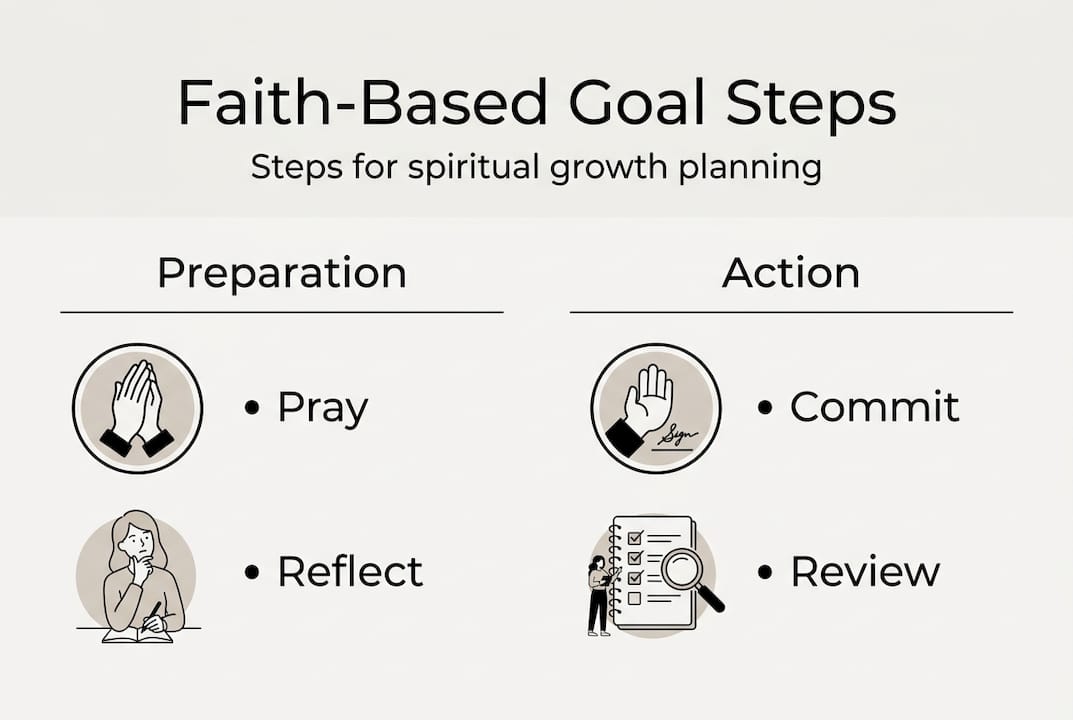
Here is the process, broken down into clear steps:
- Pray first. Ask God to reveal what He wants to develop in you right now. Do not rush this step.
- Define your purpose. Write down the spiritual value or character trait you want to grow in.
- Set the goal. Make it specific. Instead of “pray more,” write “pray for 10 minutes every morning before school.”
- Plan your action. Decide exactly when, where, and how you will work toward the goal.
- Track your progress. Use a journal, habit tracker, or app to log your consistency.
- Reflect and adjust. At the end of each week, review what is working and what needs to change.
Here is a quick look at how goals connect to spiritual values:
| Example goal | Spiritual value supported |
|---|---|
| Pray 10 minutes daily | Faithfulness, intimacy with God |
| Serve at church once a month | Generosity, humility |
| Read one Proverb per day | Wisdom, discipline |
| Forgive someone this week | Grace, freedom |
| Journal gratitude nightly | Joy, contentment |
The key is that each goal should feel like it is pulling you toward God, not just making you feel like a better person. There is a big difference between spiritual growth and self-improvement, and faith-based goals live firmly on the spiritual side.
Pro Tip: Use a free app like YouVersion’s Bible app to set reading plans and reminders. It keeps your goals visible and your progress measurable without adding stress.
Common mistakes and how to overcome them
Even with the best preparation, things can go sideways. Knowing the most common spiritual goal mistakes ahead of time means you are less likely to be caught off guard when they show up.
Here are the most frequent pitfalls and how to handle them:
- Being too vague: “I want to grow in faith” is not a goal. It is a wish. Fix it by adding specifics: what, when, and how.
- Setting unrealistic goals: Committing to a two-hour quiet time every day when you have never done 10 minutes is a setup for guilt, not growth. Start smaller.
- Neglecting prayer: Goals set without prayer can become about performance rather than relationship. Keep bringing your goals back to God regularly.
- Going it alone: Isolation makes it easy to quietly abandon goals. Find at least one person who knows what you are working toward.
- Treating setbacks as failure: Missing a day does not mean you have failed. It means you are human. Adjust and keep going.
“God is not grading your goal sheet. He is walking with you through the process. Every stumble is still a step forward when you get back up.”
One of the most overlooked mistakes is comparing your spiritual journey to someone else’s. Your goals should reflect where you are with God, not where someone else appears to be on social media. Authenticity beats performance every single time.
Measuring progress and staying motivated
Setting a goal is only half the work. Staying motivated over weeks and months is where most people struggle. Motivation in faith goals is built through consistent tracking and community, not through willpower alone.
Here are practical ways to measure progress and keep your momentum going:
- Weekly check-ins: Set aside 10 minutes every Sunday to review the past week and pray about the week ahead.
- Celebrate small wins: Did you pray every day for a week? That is worth acknowledging. Gratitude fuels motivation.
- Keep a progress journal: Write down not just what you did, but how you felt spiritually. Patterns will emerge over time.
- Revisit your why: When motivation dips, go back to the reason you set the goal. Reconnecting with purpose reignites commitment.
- Adjust without guilt: If a goal is not working, change it. Flexibility is not weakness. It is wisdom.
Pro Tip: Share your goals with a trusted friend or mentor and schedule a monthly check-in. Knowing someone is going to ask about your progress is one of the most powerful motivators there is.
Remember, the goal is not perfection. It is growth. A faith journey measured in genuine moments of connection with God is far more valuable than a perfect streak on a habit tracker.
Why faith-based goals are more than checklist items
Here is something most goal-setting content will not tell you: the structure is not the point. The relationship is. There is a real danger in turning faith-based goals into a spiritual performance, where you feel close to God when you hit your targets and distant from Him when you do not. That is not faith. That is legalism with a devotional journal.
The best faith-based goals are ones that keep pulling you back into conversation with God, not ones that make you feel like you have checked a box. A goal to read your Bible daily is only meaningful if it leads to you actually hearing from God, not just finishing a chapter. Structure is a tool, not a destination.
We believe at Stay Zealous that the most motivated Christians are not the ones with the most disciplined routines. They are the ones who have tasted real connection with God and cannot stop coming back for more. Set your goals, yes. But hold them loosely enough that the Holy Spirit can redirect you when needed. That flexibility is not a sign of weak faith. It is a sign of a living, breathing relationship.
Connect your journey with faith-inspired tools
Your faith walk deserves more than good intentions. It deserves daily reminders that you are on a mission, that your life has purpose, and that staying zealous is worth it even on the hard days.

At Stay Zealous, we create faith-inspired streetwear that does exactly that. Every piece is designed to remind you and everyone around you that your walk with the Lord is something worth showing up for. Whether you are heading to school, the gym, or just hanging with friends, wearing your faith is a small but powerful way to stay anchored to the goals you have set. Check out the collection and let your clothes carry the message your heart already believes.
Frequently asked questions
What are faith-based goals?
Faith-based goals are spiritual objectives rooted in Christian beliefs that help you grow closer to God. They connect everyday actions with deeper spiritual growth and purpose.
How can I make sure my goals are aligned with my faith?
Align your goals by praying, studying Scripture, and seeking input from trusted mentors or your church community. Prayer and introspection ensure your goals are spiritually guided rather than self-driven.
What should I do if I lose motivation?
Revisit your original purpose, pray for renewed strength, and lean on your community for support. Tracking progress alongside community accountability are two of the most effective ways to rebuild momentum.